
Coincidences might seem unusual, but they actually happen more often than we think.
My three-times-great-grandfather was born in April 1779 at Bellnollo, Fowlis Wester, Perthshire, and baptised on 4th April at Auchloy Farm. Although born at Bellnollo, he was baptised at nearby Auchloy Farm, likely because the minister was visiting.
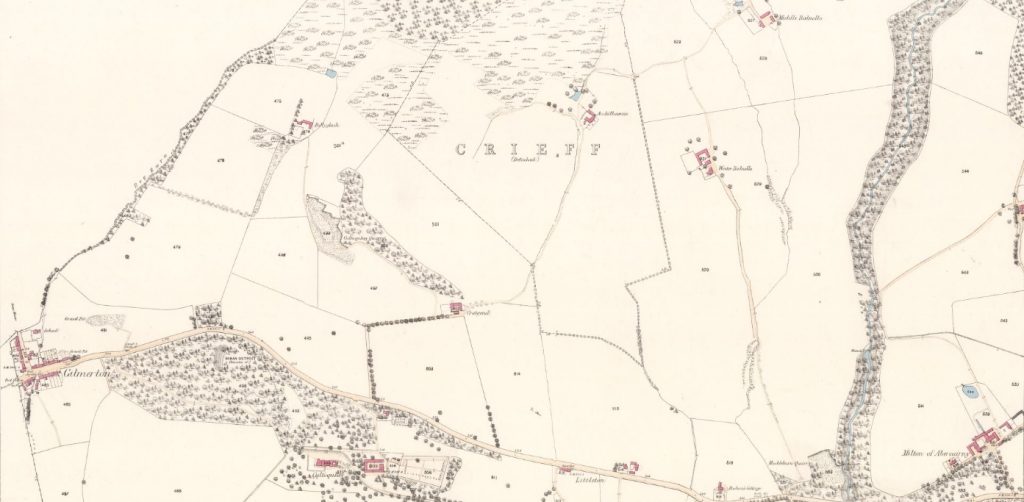
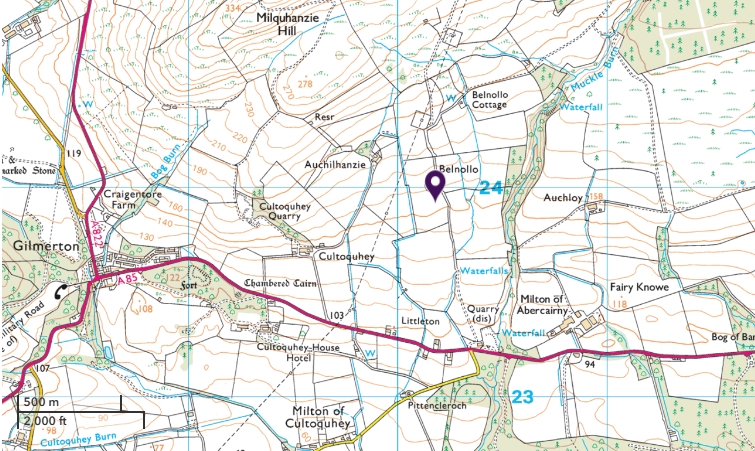
Bellnollo was almost certainly a small rural farmstead, a modest agricultural holding that formed the backbone of the parish and was worked by tenant farmers. Joseph likely worked on the farm with his parents and three brothers, growing oats, barley, potatoes, and tending cattle and sheep. The farm was largely self-sufficient, with surplus grain or cattle sold in Crieff.
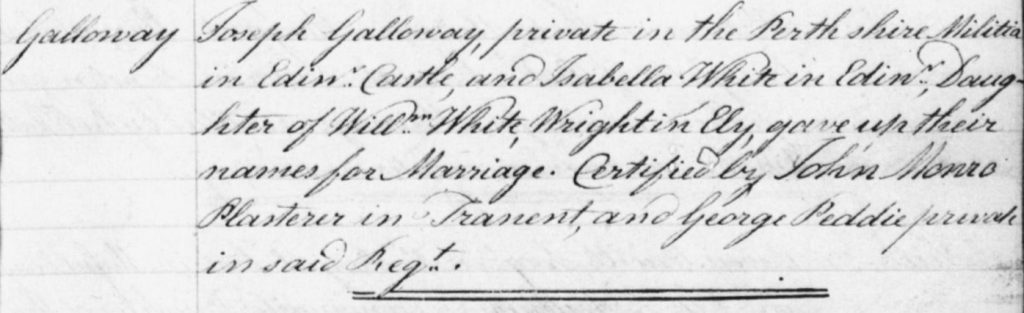
In the late 18th century, county militias were revived for the wars with Revolutionary and Napoleonic France. These were not professional army units but local defence forces drawn from ordinary men across the county. Men were chosen by ballot, not by volunteering. Every parish, including Fowlis Wester, had to supply a quota of men based on population. Before 1812, Joseph was a Private in the Perthshire Militia and was often stationed at Edinburgh Castle, where he may have met Isabella White, his future wife, whom he married on 29 February 1812 in the Canongate, Edinburgh.
After leaving the militia, Joseph and Isabella returned to Perthshire, where three of their children were born in Monzie: Agnes (1816), William and James (1817). William and James were twins, which was unusual in the 19th century, when less than 2% of births were twins. Joseph’s occupation in Monzie is unknown, but given the overwhelmingly agricultural economy, he may have been a farm labourer. In the early 19th century, agriculture in Perthshire changed. Smaller farms merged, new methods and tools were introduced, and estates and tenants were cleared. Whatever the reasons, Joseph and his family moved to Lauriston Street in Edinburgh before 1823. Between 1823 and 1834, Joseph and Isabella had five more children.
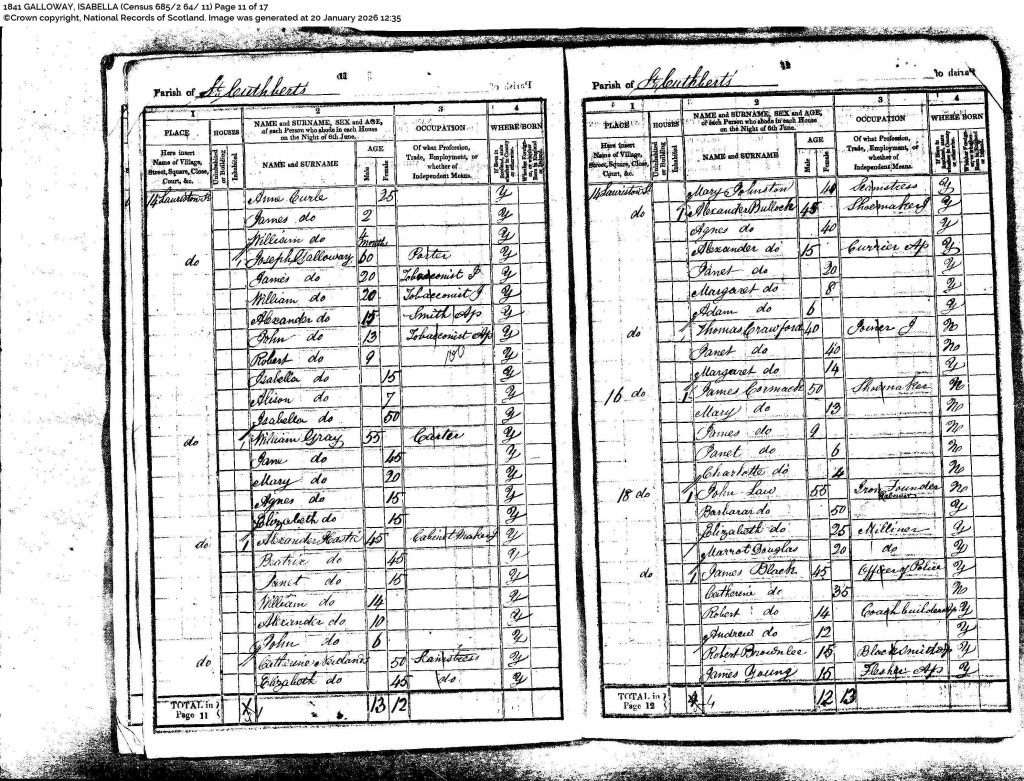
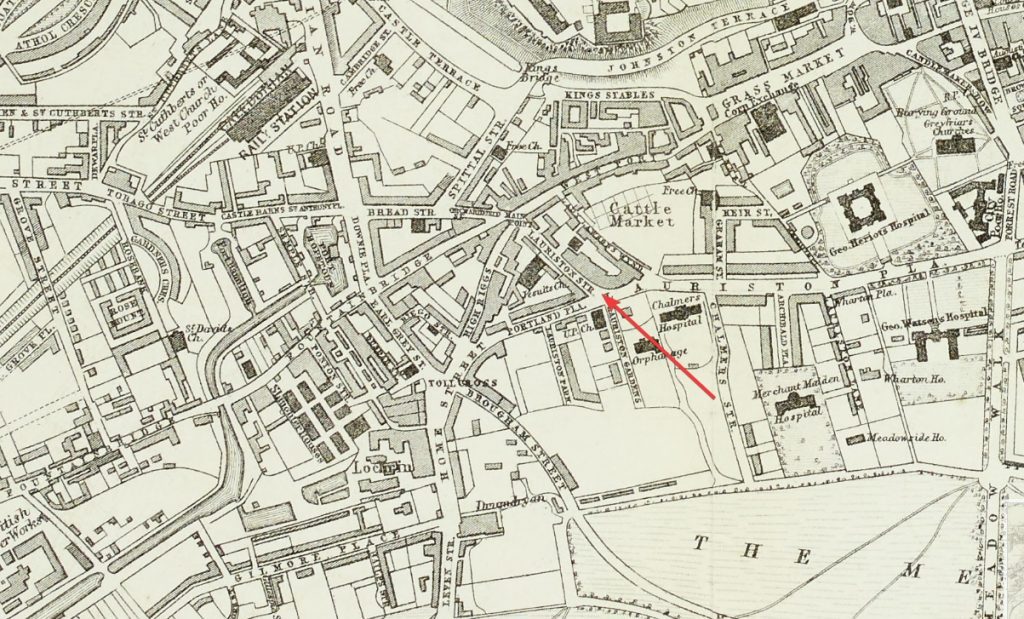
The census of 1841 shows Joseph, Isabella and their eight children: James (20), William (20), Alexander (15), John (13), Robert (9), Isabella (15), Alison (7). Agnes, their eldest child, is not listed. She has married and left home. James and William own a tobacconist shop, and you can read their story in another post. Joseph works as a porter. The census does not specify which kind, but with the nearby cattle market, the opening of the Union Canal in 1822, the opening of new roads, and the influx of families from the country, he was likely in great demand.
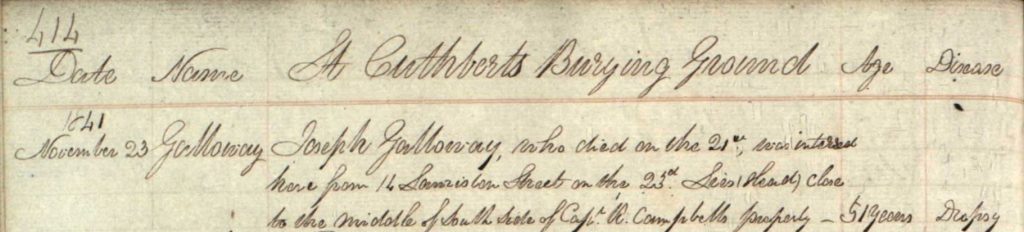
Joseph died on 21 November 1841 at his home in Lauriston Street and was buried in St Cuthbert’s Burying Ground on 23 November.
At the start, I mentioned coincidences.
While researching Joseph and the area, I discovered a link to a film about Auchloy Farm. It led me to a website called “Hole Ousia,” which means “whole being.” “Ousia” is a Greek word that can also be translated as “essence.” The films were made just for fun by Dr. Peter Scott-Gordon, who lives in Bridge of Allan.
I contacted Peter and found we had more in common than Auchloy Farm. As a child, he grew up on Thornburn Road in Colinton. I had a paper round with Harwells of Colinton, and Thornburn Road was on my route, so I likely stuffed the Scotsman through their letterbox each morning. He also had a paper round, but a few years after I did. Laverockdale House played a part in his childhood, and he helped the family in the lodge house with basic restoration work. My mum played tennis at Laverockdale.
In the summer of 1913, Joseph’s great-grandson, William Sutherland Pender Galloway (my grandfather), was a bandsman in the Edinburgh Rifles and took part in a summer exercise in Monzie.
Scotland is a small place, and if you pay attention, you’ll spot connections everywhere.
Hole Ousia
Comments are closed